
Chemistry: Grade 12 9 Sections46 Lessons7 Quizzes365 Days
1.2: Ionic Equlibria of Week Acids and Bases
Ionic Equilibria of Weak Acids and Bases
Chemistry
Lesson Competencies
At the end of this lesson, you will be able to:
Explain the concept of autoionization of water.
Use the ion-product constant for water, (K_w), to relate ([H^+]) and ([OH^-]).
Calculate pH and pOH from ion concentrations.
Define and use the ionization constants for weak acids ((K_a)) and weak bases ((K_b)) as a measure of their strength.
Perform equilibrium calculations for solutions of weak acids and bases.
Key Terms
Autoionization of Water
The process where water molecules react to form hydronium ((H_3O^+)) and hydroxide ((OH^-)) ions.
Ion-Product Constant ((K_w))
The equilibrium constant for the autoionization of water, equal to (1.0 times 10^{-14}) at 25°C.
pH and pOH
Logarithmic scales used to express the concentration of (H_3O^+) and (OH^-) ions, respectively.
(K_a) and (K_b)
The acid and base ionization constants, which measure the extent to which a weak acid or base ionizes in solution.
Video Lesson
Core Lesson: The Behavior of Weak Acids and Bases
Dear learners,
We know that strong acids like HCl dissociate completely in water, releasing all their protons. But what about weak acids, like the acetic acid in vinegar? They only release a small fraction of their protons, creating a dynamic equilibrium. Today, we’ll dive into the mathematics that governs this balance, starting with water itself.
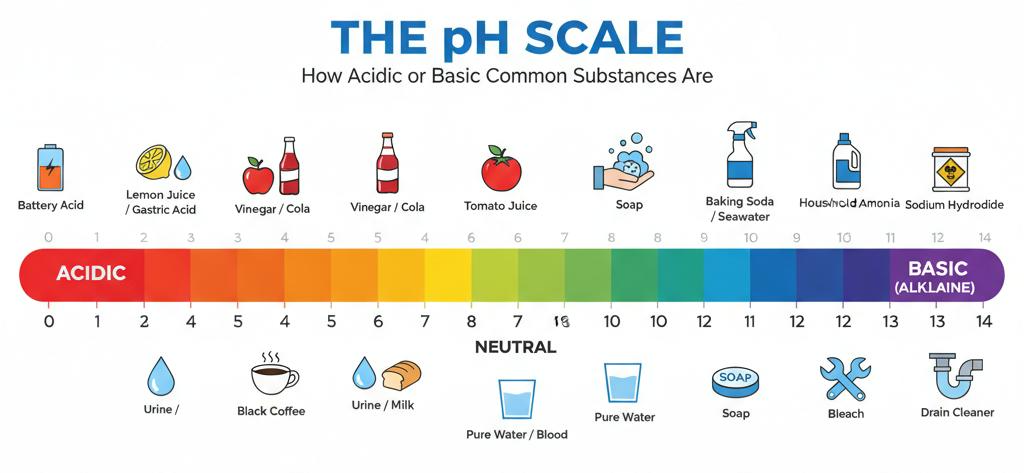
The pH scale shows how acidic or basic common substances are.
1. The Ionization of Water
Even in a glass of pure water, a tiny fraction of molecules react with each other in a process called autoionization. One water molecule donates a proton to another.
This equilibrium is described by the ion-product constant for water, (K_w). At 25°C, its value is constant:
To simplify these small numbers, we use the pH and pOH scales:
- ( mathbf{pH = -log[H_3O^+]} )
- ( mathbf{pOH = -log[OH^-]} )
- A key relationship is: ( mathbf{pH + pOH = 14} )
2. Measures of Acid and Base Strength
The strength of a weak acid or base is quantified by its equilibrium constant.
Weak Acids ((K_a))
For a generic weak acid, HA, the ionization in water is:
The acid ionization constant, (K_a), is:
A smaller (K_a) value means a weaker acid (less ionization).
Weak Bases ((K_b))
For a generic weak base, B, the ionization in water is:
The base ionization constant, (K_b), is:
A smaller (K_b) value means a weaker base (less ionization).
3. Worked Examples: Using Equilibrium Constants
The best way to understand (K_a) and (K_b) is to use them in calculations. A common tool for this is the ICE table (Initial, Change, Equilibrium).
Example 1: Calculating pH from (K_a)
Problem: What is the pH of a 0.10 M solution of acetic acid ((CH_3COOH)), given (K_a = 1.8 times 10^{-5})?
Step 1: Write the equilibrium reaction.
Step 2: Set up an ICE table.
| (CH_3COOH) | (H_3O^+) | (CH_3COO^-) | |
|---|---|---|---|
| Initial (I) | 0.10 M | ~0 M | 0 M |
| Change (C) | -x | +x | +x |
| Equil. (E) | 0.10 – x | x | x |
Step 3: Write the (K_a) expression and substitute equilibrium values.
Step 4: Make an approximation. Since (K_a) is very small, we can assume ‘x’ is negligible compared to the initial concentration (0.10 M). So, (0.10 – x approx 0.10).
Step 5: Solve for x.
This means at equilibrium, (mathbf{[H_3O^+] = x = 1.34 times 10^{-3}}) M. (Note: 1.34e-3 is much smaller than 0.10, so our approximation was valid!)
Step 6: Calculate the pH.
Percent Ionization
This calculation shows what percentage of the original acid actually ionized.
Only about 1.3% of the acetic acid molecules broke apart, which confirms it is a weak acid.
4. The Relationship Between (K_a), (K_b), and (K_w)
An essential concept is the relationship between a weak acid (HA) and its conjugate base (A⁻), or a weak base (B) and its conjugate acid (BH⁺).
For any conjugate acid-base pair, the product of their ionization constants equals the ion-product constant of water:
Example: Consider ammonia ((NH_3)) and its conjugate acid, the ammonium ion ((NH_4^+)).
- The reaction for the base ((NH_3)) is:
( small NH_3(aq) + H_2O(l) rightleftharpoons NH_4^+(aq) + OH^-(aq) quad (K_b) ) - The reaction for its conjugate acid ((NH_4^+)) is:
( small NH_4^+(aq) + H_2O(l) rightleftharpoons NH_3(aq) + H_3O^+(aq) quad (K_a) )
If you know the (K_a) for ammonium, you can find the (K_b) for ammonia simply by using:
(K_b = K_w / K_a). This is a very powerful tool!
Virtual Lab: pH Scale
Test the pH of everyday liquids like coffee and soap to determine if they are acidic, basic, or neutral.
Activity 1: Concept Check
Activity 2: Match the Concepts
Activity 3: Calculations
Lesson Summary
Pure water undergoes autoionization, creating a small but equal amount of (H_3O^+) and (OH^-) ions. This equilibrium is governed by (K_w = 1.0 times 10^{-14}).
The pH and pOH scales are convenient logarithmic measures of acidity and basicity, and are related by the simple equation (pH + pOH = 14).
The strength of a weak acid or base is measured by its ionization constant, (K_a) or (K_b). A smaller constant means a weaker substance that ionizes less.
For any conjugate acid-base pair, their constants are linked by the equation (K_a times K_b = K_w).
ICE tables are a standard method for calculating the equilibrium concentrations and pH of weak acid or base solutions.
Final Assessment
Competency Checklist
Review your learning. Can you confidently do the following?