
Economics : Grade 12 3 Sections8 Lessons365 Days
1.3:The Schools of Thought in Macroeconomic Analysis
Economics 12
Lesson Competencies
At the end of this lesson, you will be able to:
Explain the evolution of major macroeconomic schools of thought.
Differentiate between Classical and Keynesian economic theories.
Describe the core principles of Monetarism and New Classical economics.
Identify the key ideas of New Keynesian economics.
Analyze how different schools of thought propose solutions to economic problems like inflation and unemployment in an Ethiopian context.
Key Terms
Macroeconomics
The branch of economics that studies the behavior and performance of an economy as a whole.
Laissez-faire
The belief that economies function best with minimal government intervention.
Aggregate Demand
The total demand for final goods and services in an economy at a given time and price level.
Monetary Policy
Actions undertaken by a central bank (like the National Bank of Ethiopia) to manipulate the money supply and credit conditions to stimulate or restrain economic activity.
Fiscal Policy
The use of government spending and taxation to influence the economy.
Rational Expectations
The theory that people make economic choices based on their rational outlook, available information, and past experiences.
Video Lesson
Core Lesson: Understanding Economic Debates
Dear learners,
Imagine you hear a debate on the news in Addis Ababa. One expert says the government must cut taxes to boost the economy. Another insists the government should spend more on infrastructure, like roads and dams, to create jobs. A third expert argues that the National Bank of Ethiopia should simply focus on controlling the supply of the Birr to fight inflation. Why do these experts, all looking at the same Ethiopian economy, propose such different solutions?
It’s because they are looking at the problem through the lens of different macroeconomic schools of thought. These are not just abstract ideas; they are powerful frameworks that have shaped government policies around the world, including in Ethiopia, for centuries. Let’s explore the evolution of these major ideas.
Evolution of Macroeconomic Thought
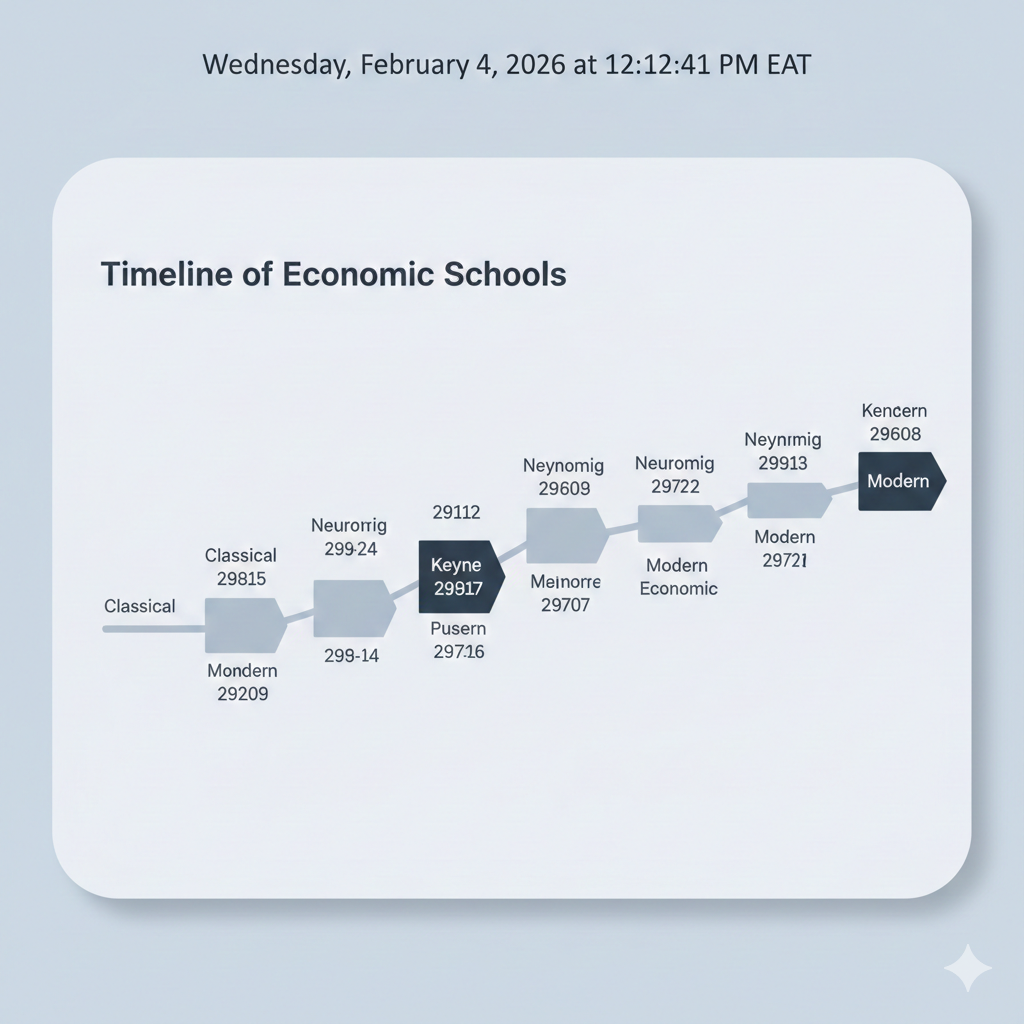
This timeline illustrates the development of major macroeconomic ideas over time, often in response to major world events.
1. The Classical School (1776 – 1930s)
Led by thinkers like Adam Smith, this was the first modern school of economic thought. Its core idea is “laissez-faire,” which means “let it be.” Classicals believe that markets are self-regulating through the “invisible hand” of supply and demand. They argue that if the government stays out, the economy will naturally achieve full employment.
Ethiopian Example: A classical economist might argue that the price of teff should be determined purely by the supply from farmers and the demand from consumers in Merkato, without any government price controls.
2. The Keynesian School (1930s – 1970s)
Developed by John Maynard Keynes during the Great Depression, this school challenged the classical view. Keynes argued that prices and wages can be “sticky” and don’t adjust quickly, leading to long periods of unemployment. He believed the government must actively intervene using fiscal policy (increasing government spending or cutting taxes) to boost aggregate demand and steer the economy back to full employment.
Ethiopian Example: The Ethiopian government’s large-scale investment in public projects like the Grand Ethiopian Renaissance Dam (GERD) or industrial parks is a Keynesian approach to create jobs and stimulate economic growth.
3. The Monetarist School (1960s – 1980s)
Led by Milton Friedman, Monetarists criticized Keynesian policies for causing inflation. They argue that the primary determinant of economic activity is the money supply. Their main policy prescription is that the central bank should focus on maintaining a slow, steady growth rate of the money supply to control inflation and provide a stable economic environment.
Ethiopian Example: A monetarist would advise the National Bank of Ethiopia to focus strictly on controlling the growth of the Ethiopian Birr in circulation to manage inflation, rather than trying to fine-tune unemployment.
4. New Classical School (1970s – onwards)
This school builds on classical ideas but adds the concept of rational expectations. They argue that people are smart and use all available information to predict the effects of government policies. Therefore, systematic and predictable policies (like a stimulus package announced months in advance) will be ineffective because people will have already adjusted their behavior, neutralizing the policy’s impact. They believe only surprise policy changes can have a short-term effect.
Ethiopian Example: If the government consistently gives subsidies to coffee farmers every year, new classical economists would say that this becomes expected. Farmers will factor this into their plans, and the subsidy will lose its power to stimulate extra production.
5. New Keynesian School (1980s – onwards)
This is a modern synthesis. New Keynesians accept the rational expectations idea from the New Classicals, but they also maintain the original Keynesian view that wages and prices are “sticky” due to factors like labor contracts and menu costs (the cost for a restaurant to print new menus). Because of this stickiness, they believe that even predictable monetary and fiscal policies can have a real impact on the economy, and they support a role for government intervention to stabilize the economy.
Ethiopian Example: A large textile company in Hawassa might have a two-year wage agreement with its workers. Even if there’s a small economic downturn, the company can’t immediately cut wages. This “stickiness,” a core New Keynesian idea, means that a government stimulus could help the company avoid layoffs.
Activity 1: Check Your Understanding (MCQ)
Activity 2: Match the Concepts
Drag the economist or key concept to the correct school of thought.
Concepts & People
Schools of Thought
Classical
Keynesian
Monetarist
Activity 3: Mixed Challenge
Lesson Summary
Classical: Believes in self-regulating markets and minimal government intervention (laissez-faire).
Keynesian: Advocates for active government intervention (fiscal policy) to manage aggregate demand and fight unemployment.
Monetarist: Focuses on controlling the money supply as the key to economic stability and controlling inflation.
New Classical: Introduces rational expectations, suggesting predictable government policies are often ineffective.
New Keynesian: A modern blend that accepts rational expectations but points to “sticky” wages and prices as a reason why government policy can still be effective.
Final Assessment
Competency Checklist
Check the boxes to confirm your understanding.