
Science: Grade 7 11 Sections54 Lessons365 Days
1.5 Uses, Safety Rules and Procedures in Science Laboratories
Uses, Safety Rules and Procedures in Science Laboratories
Grade 7 General Science
Lesson Competencies
At the end of this lesson, you will be able to:
- Identify common science laboratory equipment and their uses.
- Explain the importance of laboratory safety rules.
- Demonstrate correct procedures for handling chemicals and equipment.
- Apply emergency procedures in case of accidents in the lab.
Key Terms
Laboratory
A special, controlled room where scientific experiments and research are conducted safely.
Hazardous
Something that is dangerous or risky, especially to one’s health (like certain chemicals).
Apparatus
The technical equipment or machinery needed for a particular scientific activity or purpose.
Wafting
A safe method to smell chemicals by using your hand to gently wave the vapor towards your nose.
Video Lesson: Lab Safety Rules
Watch this short video to see a demonstration of proper lab safety.
Core Lesson: Inside the Science Lab
Introduction
Dear learners,
Imagine you are a detective trying to solve a mystery. To find clues, you need special tools and a safe place to work. For a scientist, this special place is the laboratory! Today, Abebe and Chaltu are entering the Grade 7 science lab for the first time. They are excited to mix chemicals and look through microscopes, but first, they must learn how to be safe.
Uses of the Science Laboratory
A science laboratory is a facility that provides controlled conditions in which scientific research, experiments, and measurement may be performed. We use laboratories to:
- Test scientific theories we learned in class.
- Discover new facts by observing chemical reactions.
- Measure properties like mass, volume, and temperature accurately.
Essential Safety Rules
The lab contains delicate glassware and chemicals that can be hazardous. To keep everyone safe, we must follow strict rules:
1. Dress Appropriately
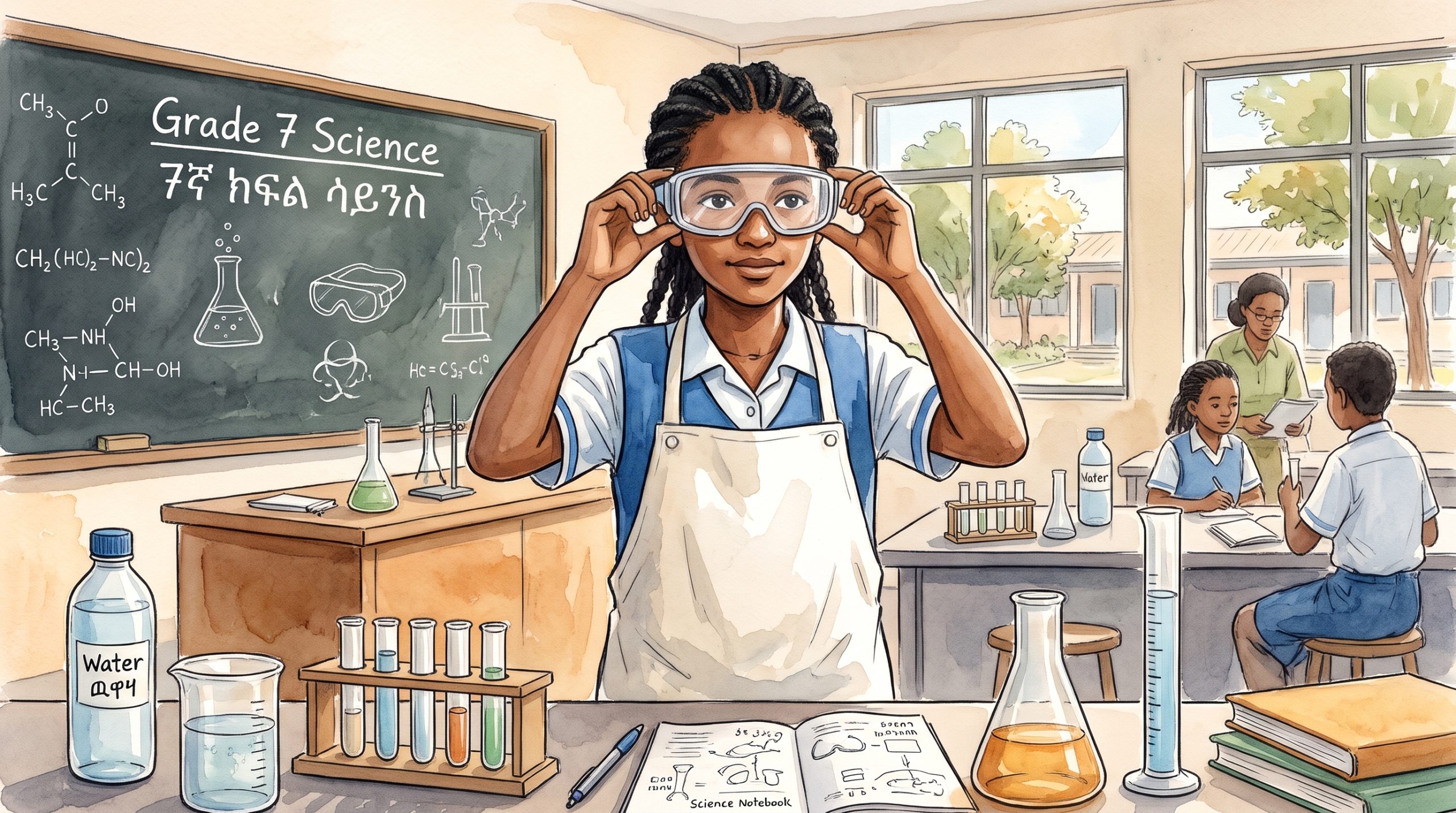
Always wear safety goggles to protect your eyes. Tie back long hair and do not wear loose clothing or open-toed shoes.
2. No Food or Drink
Never eat, drink, or taste anything in the laboratory. Chemicals can accidentally contaminate your food.
3. Smelling Chemicals
Never smell a chemical directly. Use the wafting technique by gently waving your hand over the container towards your nose.
4. Clean Up
Keep your workspace clean. Report any spills or broken glass to your teacher immediately. Never clean broken glass with your bare hands.
Emergency Procedures
Even with careful procedures, accidents can happen. If a chemical gets in your eyes, immediately use the eye wash station for at least 15 minutes. If a fire starts, notify the teacher and use the fire blanket or extinguisher as directed.
Illustration: Lab Safety Gear
Virtual Lab Simulation
Practice building an atom in a safe virtual environment before we handle real materials in the lab!
Game: The Safety Sorter
Abebe needs your help! Sort these laboratory behaviors into the “Safe” or “Unsafe” bins.
Mobile Users: Tap an action, then tap the bin to place it!
Actions to Sort:
SAFE ACTIONS
UNSAFE ACTIONS
Activity 1: Multiple Choice
Activity 2: Match Equipment
Match the laboratory equipment to its correct use. Tap an item, then tap the empty dashed box to place it.
Equipment Bank
Uses
Activity 3: True or False Challenge
Lesson Summary
A science laboratory is a special place designed for safe scientific experiments.
Common equipment includes the beaker (for liquids), microscope (for tiny objects), and balance (for mass).
Safety is the priority! Always wear safety goggles, never eat or drink in the lab, and do not run.
Use the wafting technique to smell chemicals safely.
In an emergency, report to the teacher immediately and use safety stations (like the eye wash) if needed.
Final Assessment
Competency Checklist
Check off the skills you have mastered in this lesson: