
Geography: Grade 11 12 Sections47 Lessons365 Days
1.4. Changing position of the continents and oceans
Grade 11 Geography
Lesson Competencies
At the end of the lesson you will be able to:
Explain the theory of continental drift as proposed by Alfred Wegener.
Describe the key evidence supporting the movement of continents.
Define plate tectonics and explain its role as the mechanism for continental movement.
Understand the concept of supercontinents, including Rodinia and Pangea.
Key Terms
Continental Drift
The theory that Earth’s continents have moved over geologic time relative to each other, appearing to have “drifted” across the ocean bed.
Plate Tectonics
The scientific theory describing the large-scale motion of seven large plates and movements of smaller plates of the Earth’s lithosphere.
Rodinia
A Neoproterozoic supercontinent that assembled 1.1–0.9 billion years ago and broke up 750–633 million years ago. One of the oldest known.
Pangea
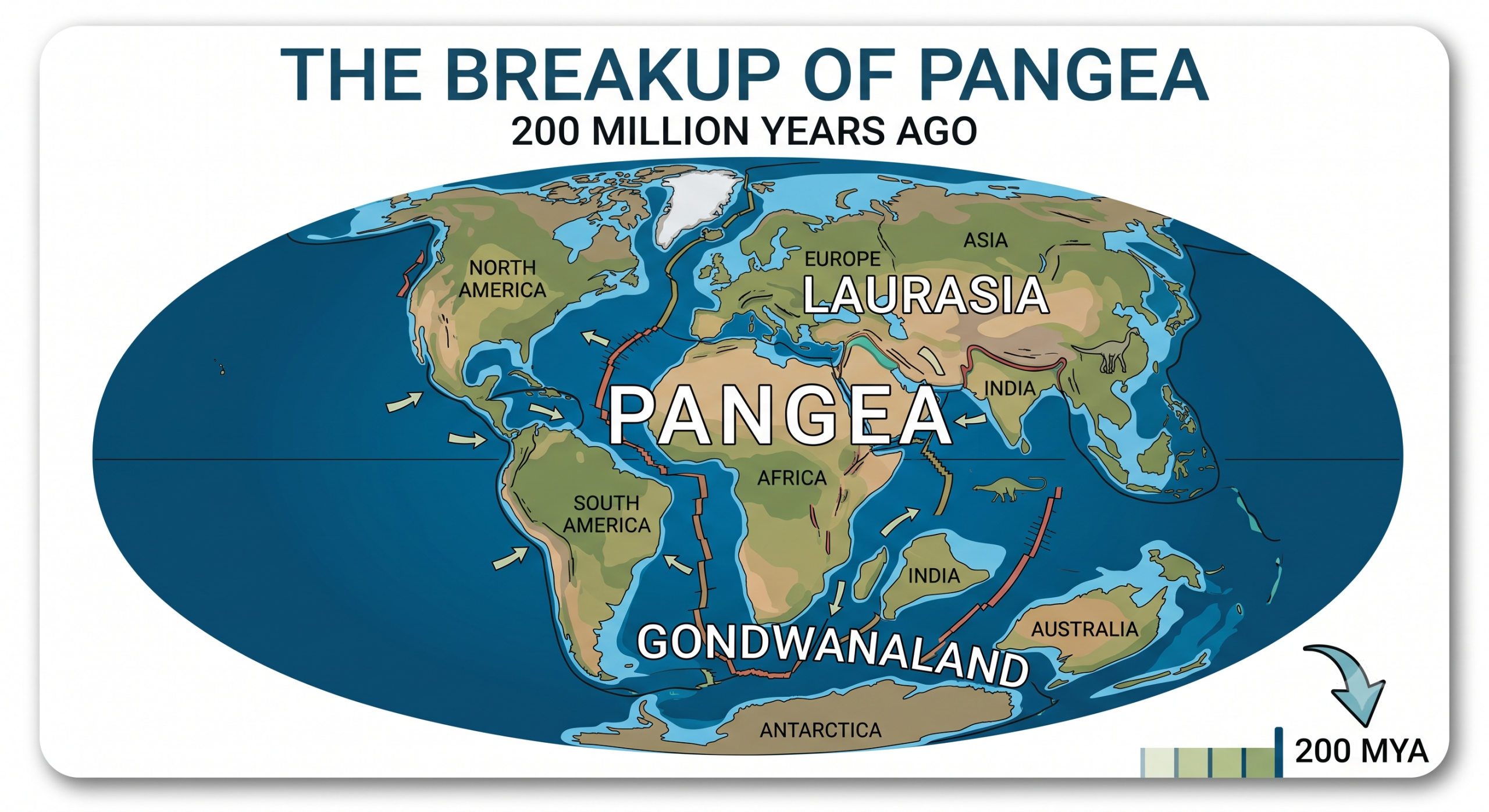
A supercontinent that existed during the late Paleozoic and early Mesozoic eras. Assembled ~335 million years ago, began breaking apart ~175 million years ago.
Video Lesson
Core Lesson: Earth’s Shifting Surface
Introduction
Dear learners,
Have you ever looked at a world map and noticed how the coastlines of some continents look like puzzle pieces that could fit together? For example, the east coast of South America and the west coast of Africa. For centuries, mapmakers noticed this, but it wasn’t until the 20th century that scientists understood why.
Our planet’s surface is not static. The solid ground we walk on is constantly moving, albeit incredibly slowly. This movement has shaped everything from the highest mountains to the deepest oceans.
Wegener’s Big Idea: Continental Drift
In 1912, a German meteorologist named Alfred Wegener proposed a radical idea. He suggested that all the continents were once joined together in a single, massive supercontinent he called Pangea (meaning “all earth”).
Wegener proposed the theory of Continental Drift, stating that Pangea broke apart and the continents slowly drifted to their current positions. However, Wegener couldn’t explain *how* they moved, so many scientists initially rejected his idea.
The Evidence for Drifting Continents
Wegener gathered four main types of evidence to support his theory:
1. The Jigsaw Puzzle Fit
The most obvious evidence. The coastlines of South America and Africa align remarkably well, like pieces of a broken plate.
2. Fossil Evidence
Fossils of the same plants and reptiles (like the freshwater reptile Mesosaurus) were found on continents now separated by vast oceans.
3. Rock & Mountain Correlation
Identical rock layers and mountain ranges (like the Appalachians in the US and Caledonian mountains in Scotland) match up when continents are brought together.
4. Glacial Evidence
Evidence of ancient glaciers is found in currently warm areas (like India and Africa), suggesting these lands were once closer to the South Pole.
The Mechanism: Plate Tectonics
Decades after Wegener’s death, modern science mapped the ocean floor and discovered the mechanism he lacked: Plate Tectonics. The Earth’s outer shell (lithosphere) isn’t one solid piece; it’s broken into several large tectonic plates.
These plates float on a semi-fluid layer of the mantle (asthenosphere) beneath them. Heat from the Earth’s core causes convection currents in the mantle, acting like a conveyor belt that slowly moves the plates above.
Supercontinents: Before and After Pangea
The continents come together and break apart in a cycle spanning hundreds of millions of years. Before Pangea existed (~335 million years ago), there were older supercontinents. One of the oldest known is Rodinia, which formed over a billion years ago.
Local Connection: Ethiopia’s Shifting Land
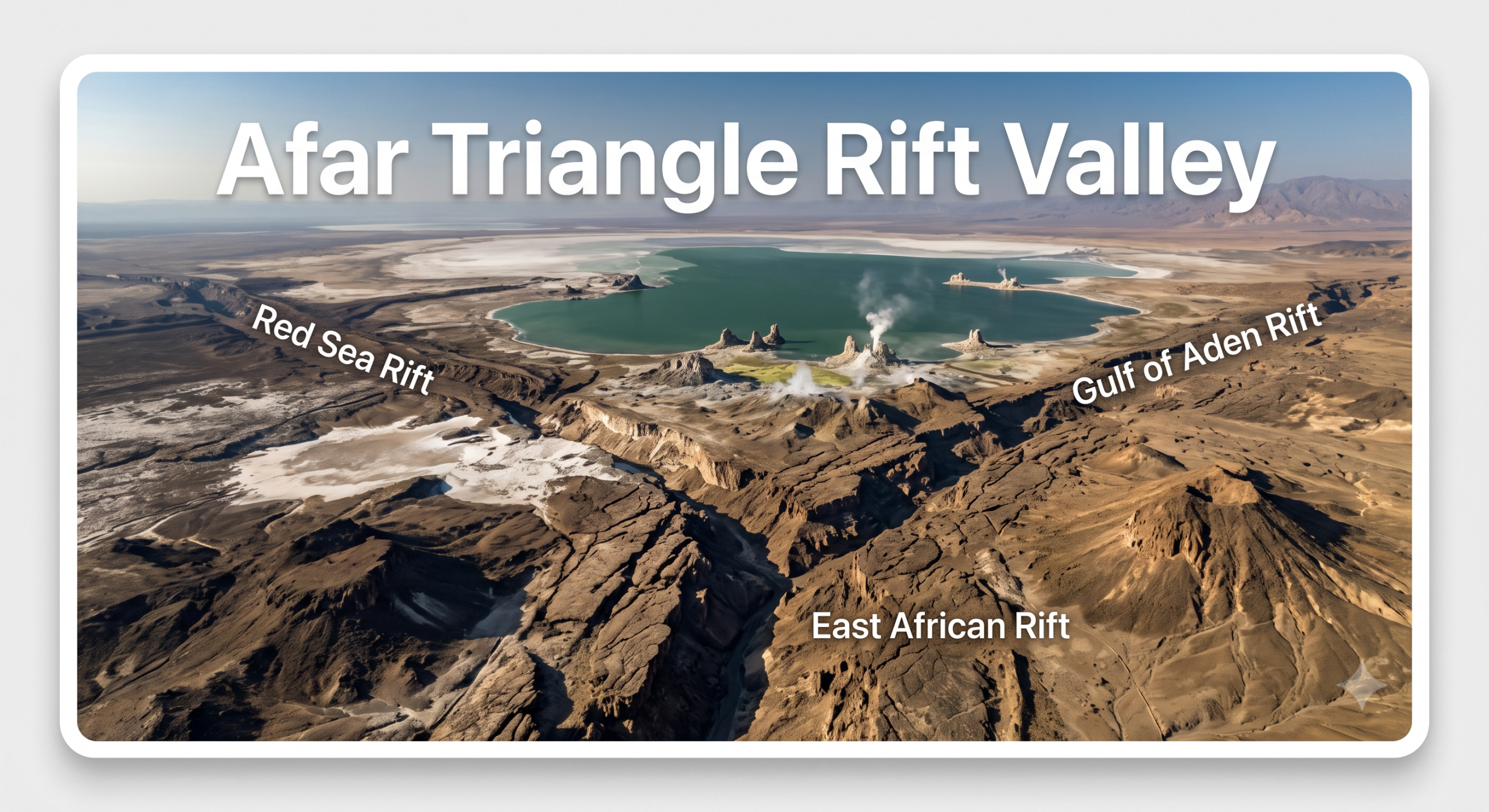
Plate Tectonics is not just ancient history; it is happening right now in Ethiopia! The East African Rift System (ስምጥ ሸለቆ) is one of the most visible examples of continental movement on Earth today.
In the Afar Triangle (Danakil Depression), three tectonic plates—the Nubian Plate, the Somali Plate, and the Arabian Plate—are slowly pulling apart from each other. This is known as a divergent boundary.
As the plates separate, magma rises from the mantle, creating active volcanoes like Erta Ale. Millions of years from now, this rift will widen so much that the Red Sea will flood in, creating a new ocean and splitting the Horn of Africa away from the rest of the continent!
Game: Evidence Matcher
Why this matters:
Understanding Wegener’s four main pieces of evidence is crucial because they formed the foundation of the Continental Drift theory *before* plate tectonics was discovered. This interactive activity helps you memorize and connect each scientific term with its real-world observation.
Instructions: Tap an evidence type to select it, then tap the correct empty box next to its description to place it.
Evidence Bank
Descriptions
Activity 1: Knowledge Check
1 / 5Objective: This activity tests your basic recall of the historical figures, key terminology (like Pangea), and fundamental concepts introduced in the lesson. Read the feedback after each question to reinforce your learning!
Activity 2: True or False
1 / 5Objective: True or False questions help clarify common misconceptions about geology. Pay close attention to the specific wording regarding how and why continents move, and use the post-answer explanations to correct any misunderstandings.
Activity 3: Mixed Challenge
1 / 5Objective: This mixed challenge requires you to synthesize information. You’ll need to apply your knowledge to new scenarios, like identifying non-evidence or understanding geographical timelines. Take your time to think through the logic!
Lesson Summary
Continental Drift is the theory that continents move over Earth’s surface, proposed by Alfred Wegener.
Evidence includes the jigsaw fit of continents, matching fossils, rock formations, and past climates (glaciers).
Plate Tectonics explains how continents move: Earth’s lithosphere is divided into plates moving over the asthenosphere.
Pangea was a recent supercontinent (~335m years ago); Rodinia was an older one (~1 billion years ago).
The Great Rift Valley in Ethiopia is a modern example of continents splitting apart due to tectonic forces.
Final Assessment
1 / 5Objective: This final assessment evaluates your comprehensive mastery of the lesson’s competencies. Detailed explanations are provided for every answer to ensure complete understanding before you finish the module.
Self-Assessment Checklist
Check the boxes for the skills you feel you have mastered in this lesson.