
History: Grade 10 12 Sections43 Lessons365 Days
1.2 Unification of Italy
Unification of Italy
History Grade 10
Lesson Competencies
At the end of the lesson you will be able to:
Define nationalism and identify its historical roots.
Explain the political and territorial fragmentation of Italy before unification.
Identify the three main obstacles to Italian unification.
Describe the roles of Giuseppe Mazzini, Count Cavour, and Giuseppe Garibaldi.
Outline the key events that led to the unification.
Discuss the challenges Italy faced after unification.
Key Terms
Nationalism
A strong feeling of pride in and devotion to one’s country, often involving the desire for independent self-rule.
Risorgimento
Meaning “Resurgence” or “Revival,” it was the ideological and literary movement that helped arouse the national consciousness of the Italian people.
Red Shirts
The volunteer army of Giuseppe Garibaldi who fought to liberate southern Italy.
Papal States
Territories in the central Italian Peninsula under the direct sovereign rule of the Pope until 1870.
Video Lesson
Watch this brief overview to visualize the journey of Italian Unification before we dive into the details.
Core Lesson: Forging a Unified Nation
Introduction
Dear learners,
Imagine living in a land where people share the same language, culture, and history, yet are divided by borders into many small, weak states ruled by foreign kings. This was the reality of Italy in the early 19th century.
Making Connections: To understand Italy’s situation, think about Ethiopian history during the Zemene Mesafint (Era of the Princes). Ethiopia was divided among various regional lords fighting for power, until Emperor Tewodros II began the difficult process of unifying the nation under one central authority. Italy faced a similar challenge!
1. Nationalism and Fragmentation
Nationalism is the belief that people who share a common heritage should live together in an independent nation. The roots of Italian nationalism grew heavily during the French Revolution and Napoleon’s conquests, which showed Italians the benefits of unity and modern laws.
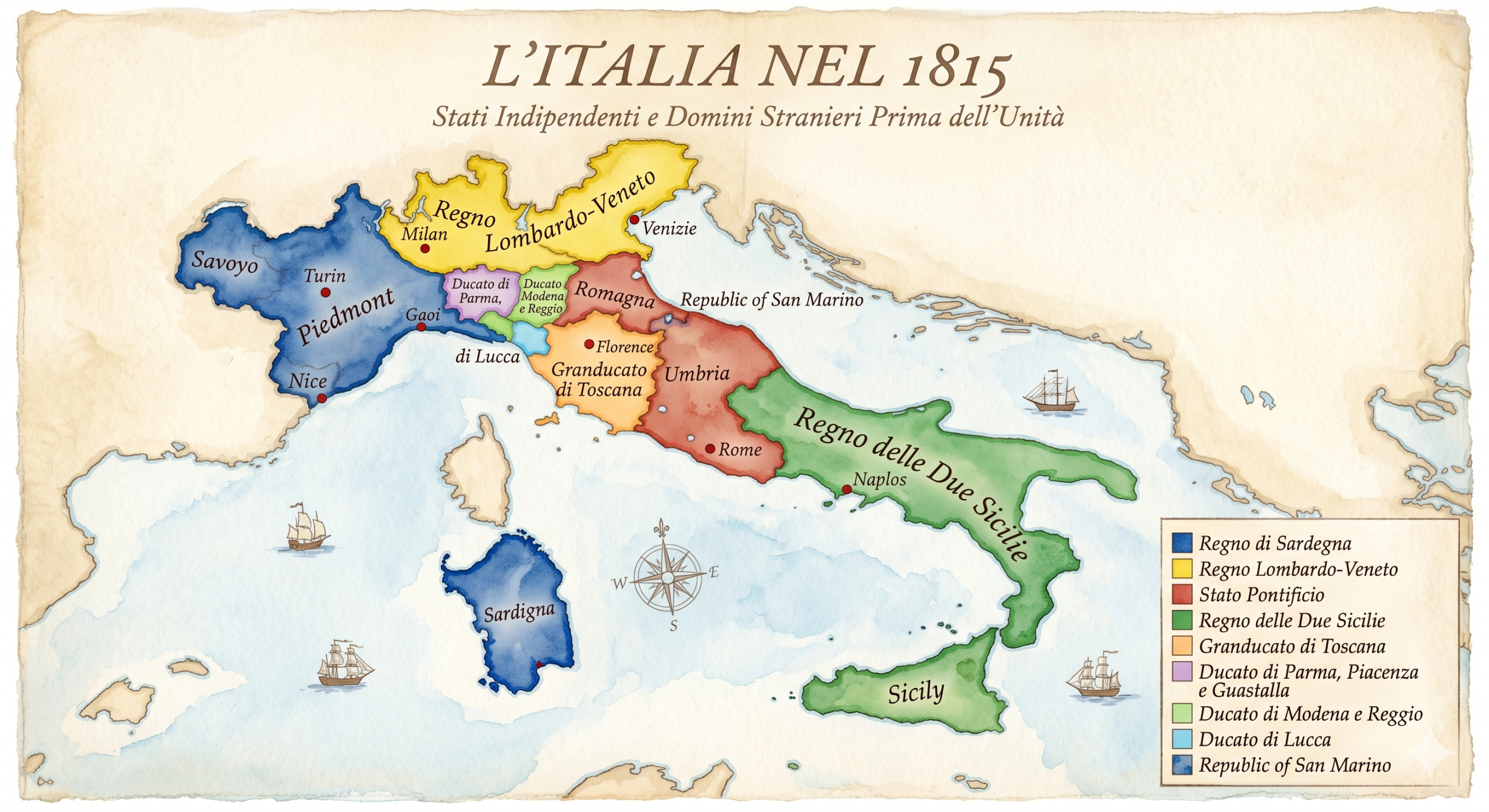
Before unification, the Italian peninsula was heavily fragmented. The Congress of Vienna (1815) divided Italy into separate states: the South was ruled by the Bourbon dynasty (France/Spain), the Center by the Pope, and the North was heavily controlled by the Austrian Empire.
2. The Three Obstacles to Unification
Austria
The powerful Austrian Empire controlled wealthy northern regions like Lombardy and Venetia and crushed nationalist rebellions.
The Papacy
The Pope ruled the Papal States in central Italy and feared losing his temporal (political) power over the region.
Local Princes
Various local monarchs wanted to keep their independent thrones rather than submit to a united government.
3. The Architects of Italy
Three extraordinary leaders played distinct roles in the Risorgimento (the unification movement), often referred to as the Heart, the Brain, and the Sword.
- Giuseppe Mazzini (The Heart): A visionary writer who founded Young Italy, a secret society aimed at creating a unified, democratic republic. He inspired the youth with his passionate nationalism.
- Count Camillo di Cavour (The Brain): The Prime Minister of Piedmont-Sardinia. A brilliant politician who used diplomacy, alliances (especially with France), and wars to drive Austria out of northern Italy.
- Giuseppe Garibaldi (The Sword): A bold military commander. He led a volunteer army known as the Red Shirts to liberate the Kingdom of the Two Sicilies in the south, eventually handing the territory over to the northern King.
4. Key Events and Post-Unification Challenges
Through Cavour’s diplomacy and Garibaldi’s conquests, most of Italy was united in 1861 under King Victor Emmanuel II. Venetia was added in 1866, and finally, Rome was captured in 1870, completing the unification.
However, the new nation faced severe challenges:
- Economic Divide: The North was becoming industrial and rich, while the South remained rural and impoverished.
- Political Tensions: Only a small percentage of men could vote initially, and the Pope ordered Catholics not to participate in the new state’s politics.
Historical Map Concept
Activity 1: Knowledge Check
Select the best answer for each question.
Activity 2: Match the Leaders
Tap-to-Select, Tap-to-Place: Tap a historical figure from the bank, then tap the empty dashed box next to their correct description.
Historical Figures Bank
Descriptions
Activity 3: Mixed Challenge
Test your understanding with True/False and Fill-in-the-Blanks.
Lesson Summary
Nationalism drove the desire for Italians to govern themselves free from foreign rule.
Italy was fragmented due to Austria, the Papal States, and local monarchs wanting to keep power.
The unification (Risorgimento) was championed by Mazzini (ideas), Cavour (diplomacy), and Garibaldi (military).
By 1870, Italy was unified under King Victor Emmanuel II.
Post-unification, Italy struggled with a sharp economic divide between the industrial North and rural South.
Final Assessment
Complete this final quiz to record your progress.
Competency Checklist
Self-assess your learning. Check the boxes for the skills you have mastered.