
Geography: Grade 9 12 Sections48 Lessons365 Days
1.2. location, size and shape of Ethiopia
Location, Size, and Shape of Ethiopia
Geography Grade 9
Lesson Competencies
At the end of the lesson you will be able to:
Define and differentiate between relative and astronomical location.
Identify Ethiopia’s neighboring countries and describe its vicinal location.
Locate Ethiopia on a map using its specific latitude and longitude.
Analyze the advantages and disadvantages of Ethiopia’s size and shape.
Key Terms
Relative Location
Describing a place’s position in relation to other known places or landmarks.
Astronomical Location
The precise, exact position of a place on Earth defined by coordinates of latitude and longitude.
Vicinal Location
A type of relative location that describes a place in relation to its immediate neighboring countries or bodies of water.
Compactness
A geographic term used to describe how close a country’s shape is to being circular, which can affect governance and defense.
Video Lesson
Core Lesson: Finding Ethiopia in the World
Dear learners,
Have you ever described where your home is by saying it’s “next to the school” or “across from the market”? That’s called relative location. But you could also give its exact address. Countries are the same! Their position on the map is not just a random spot; it has shaped our history, culture, and economy.
Today, we will learn how to describe Ethiopia’s location in two main ways. We will also explore its size and shape, and think critically about how these geographic features affect our country.
1. Location of Ethiopia
Location can be described in two ways: relative and astronomical (or absolute).
A. Relative Location
This describes Ethiopia’s position in relation to its surroundings. There are two important types:
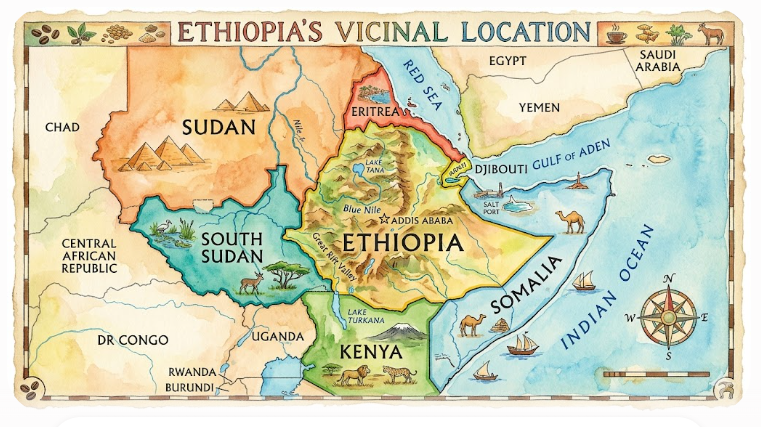
- Vicinal Location: This refers to our immediate neighbors. As a landlocked country, Ethiopia is bordered by six countries: Eritrea to the north, Djibouti to the east, Somalia to the east and southeast, Kenya to the south, South Sudan to the west, and Sudan to the northwest.
- Strategic Location: This refers to its position relative to important global features. Ethiopia is strategically located in the Horn of Africa, close to the Middle East and major shipping lanes in the Red Sea and the Indian Ocean. This position has historically made it a center for trade and politics.
B. Astronomical (Absolute) Location
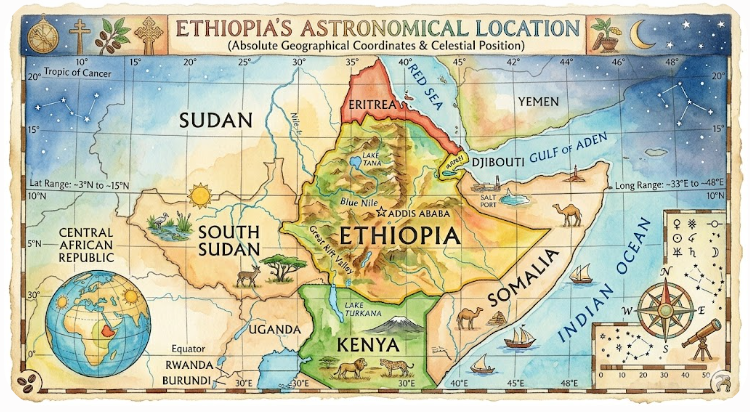
This gives Ethiopia’s precise location using the grid system of latitude and longitude.
- Latitude: Ethiopia lies between 3°N (in the south) and 15°N (in the north) of the Equator. This places it entirely within the Northern Hemisphere and the tropical zone.
- Longitude: It is located between 33°E (in the west) and 48°E (in the east) of the Prime Meridian. This places it entirely within the Eastern Hemisphere.
2. Size of Ethiopia
Ethiopia has a total area of about 1,106,000 square kilometers (as of 2012), making it the second largest country in the Horn of Africa after Sudan.
| Country | Total area (in sq.kms) | Rank | Size in comparison to Ethiopia |
|---|---|---|---|
| Ethiopia | 1,106,000 | 2 | – |
| Sudan | 1,849,233 | 1 | 1.01 times bigger |
| Somalia | 637,661 | 3 | 1.73 times smaller |
| Kenya | 580,000 | 5 | 1.91 times smaller |
| Eritrea | 118,000 | 6 | 9.42 times smaller |
| Djibouti | 23,200 | 7 | Almost 50 times smaller |
| South Sudan | 631,928 | 4 | 1.75 times smaller |
Advantages of a Large Size
- Diverse climates and ecosystems.
- Greater variety and quantity of natural resources.
- Large population for labor and defense.
- Cultural and linguistic diversity.
Disadvantages of a Large Size
- Difficult and expensive to administer and govern.
- Requires large, costly infrastructure (roads, etc.).
- Can be difficult to defend long borders.
- May lead to regional inequalities.
3. Shape of Ethiopia
A country’s shape can be measured by its level of compactness. A compact shape is one that is close to a circle, which is often considered ideal for administration and communication. Ethiopia’s shape is considered to be relatively compact.
We can measure compactness using indicators, but a simple way to think about it is how easily the capital city can connect to all parts of the country. A more circular shape makes this easier than a long, thin, or fragmented shape.
Activity 1: Check Your Knowledge
Activity 2: Fact or Fiction?
Activity 3: Select the Best Term
Lesson Summary
Ethiopia’s location can be described in two ways: Relative Location (in relation to its neighbors like Sudan and Kenya) and Astronomical Location (its precise position between 3°N-15°N latitude and 33°E-48°E longitude).
As one of Africa’s largest countries, its size offers advantages like diverse resources, but also challenges such as difficult administration and high infrastructure costs.
Finally, Ethiopia’s shape is considered relatively compact, which is generally beneficial for transportation, communication, and governance.
Final Assessment
Test your overall knowledge of the lesson. Complete all questions to conclude the topic.
Competency Checklist
Check off the skills you’ve mastered in this lesson to finish your progress.