
Social studies: Grade 7 13 Sections48 Lessons365 Days
1.1 Origin of the earth and the solar system
Origin of the Earth and the Solar System
Social Studies Grade 7
Lesson Competencies
At the end of the lesson you will be able to:
Describe the origin of the Earth and the solar system.
Identify the main members of our solar system.
Explain the key characteristics of the Sun, planets, asteroids, and meteoroids.
Differentiate between inner and outer planets.
Key Terms
Solar System
The collection of the Sun and all celestial bodies traveling in orbit around it.
Sun
The star at the center of our solar system that supplies heat and light to Earth.
Planet
A large celestial body that orbits a star and does not produce its own light.
Asteroids
Small, rocky objects that orbit the Sun, mostly found in a belt between Mars and Jupiter.
Meteoroid
A small piece of rock or metal from space. Called a meteor in the atmosphere, meteorite on ground.
Orbit
The curved path that a planet, satellite, or spacecraft takes as it revolves around another body.
Inner Planet
The four rocky planets closest to the Sun: Mercury, Venus, Earth, and Mars.
Outer Planet
The four large, gaseous planets furthest from the Sun: Jupiter, Saturn, Uranus, and Neptune.
Video Lesson
Core Lesson: Our Place in the Cosmos
Dear learners,
Imagine you’re looking up at the night sky. Have you ever wondered how our own planet, Earth, and its neighbors came to be? How was this giant cosmic neighborhood, our solar system, formed?
The Birth of Our Solar System
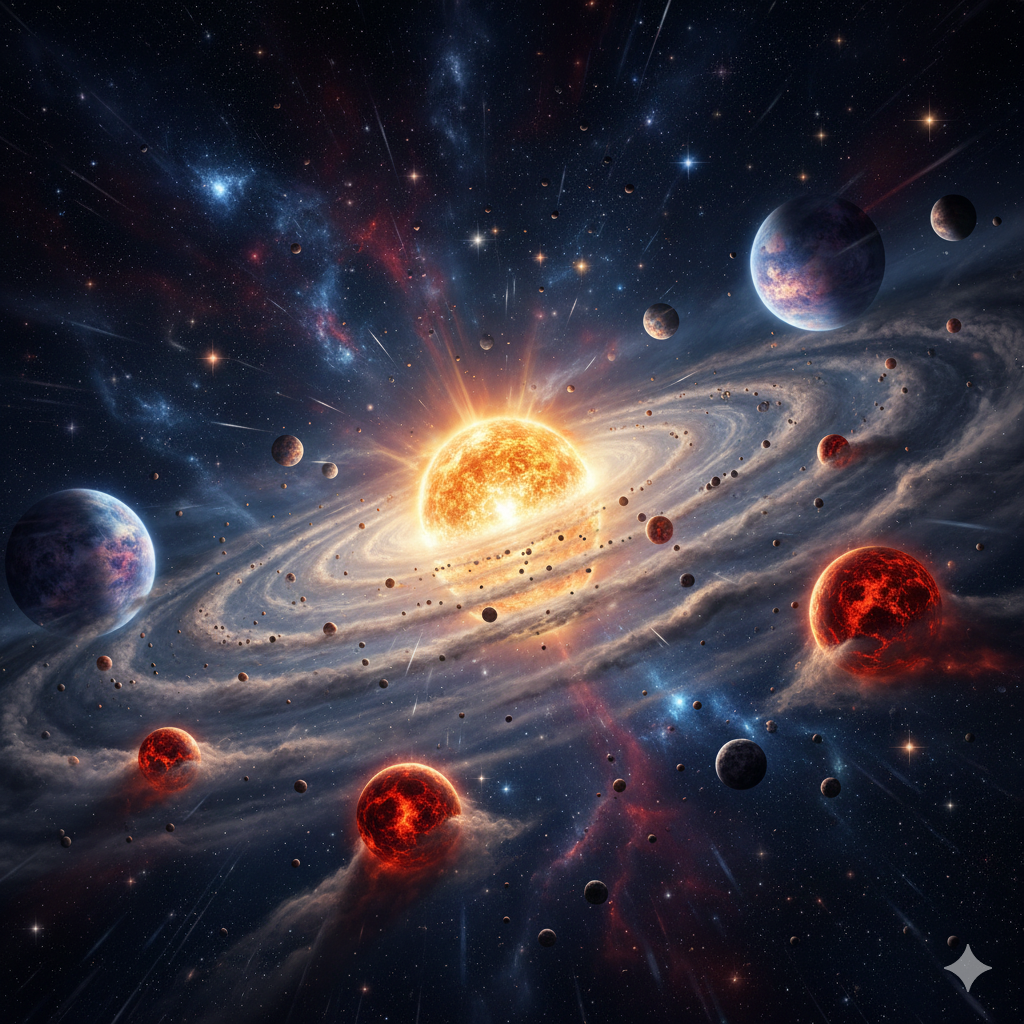
Scientists believe our solar system began as a giant, swirling cloud of gas and dust called a nebula.
1. The Nebular Theory
The Nebular Hypothesis suggests that about 4.6 billion years ago, this massive nebula started to collapse under its own gravity. As it collapsed, it spun faster and flattened into a disk.
2. The Sun is Born
Most gas and dust gathered at the center. The pressure and temperature became so high that nuclear fusion began. Our Sun was born, comprising 99.8% of the system’s mass.
3. The Planets Form
The remaining dust and gas clumps collided and stuck together, growing into planets, moons, and asteroids. The planets follow a specific orbit around the Sun.
Members of the Solar System
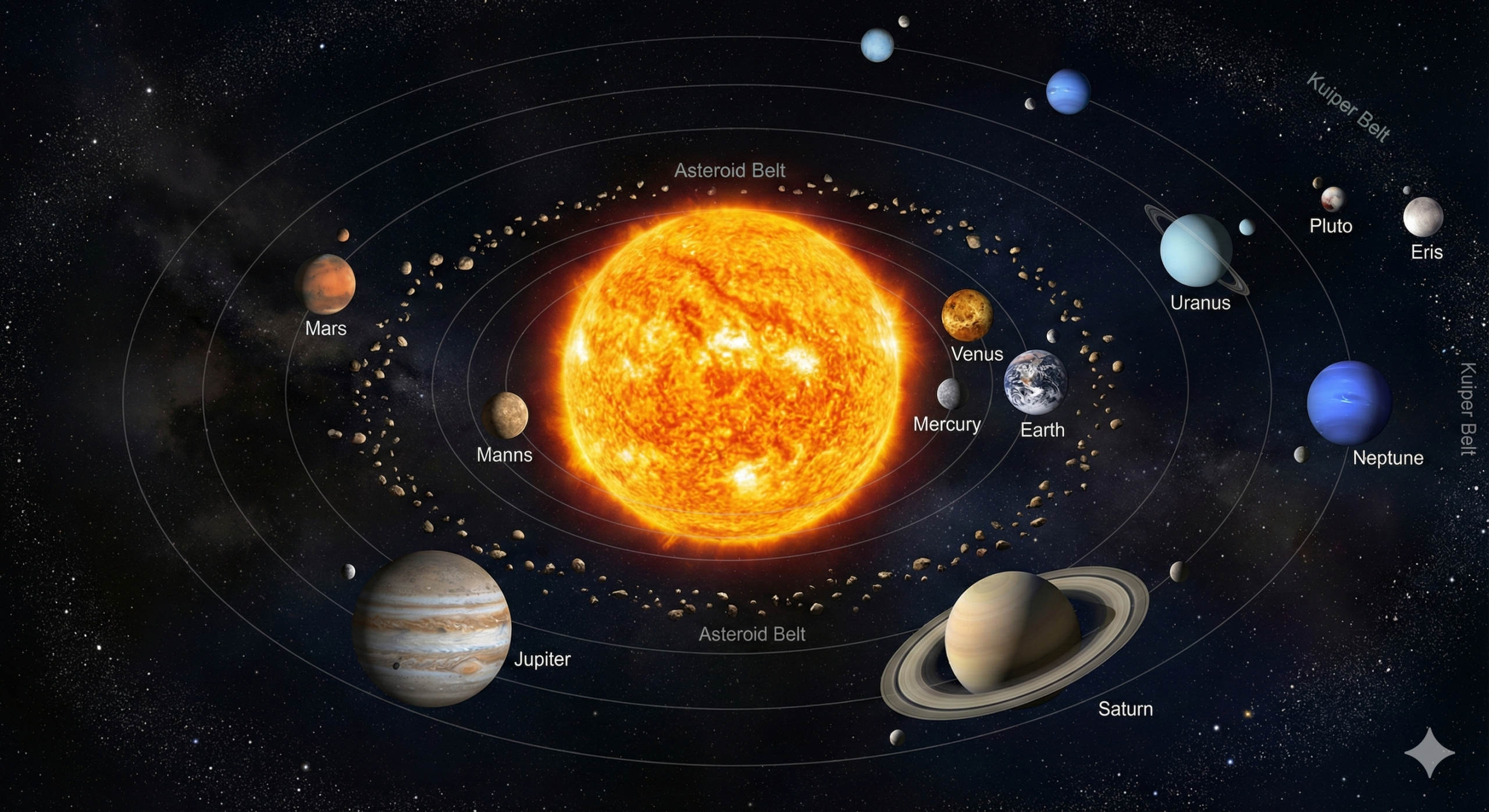
The Inner Planets
Terrestrial planets (Mercury, Venus, Earth, Mars) are closest to the Sun, smaller, rockier, and denser.
The Outer Planets
Gas giants (Jupiter, Saturn, Uranus, Neptune) are larger and composed mostly of gas and ice.
Nebular Timeline Lab
Reconstruct the history! Click the events below in the correct chronological order to show how our solar system formed.
Event Bank (Click to place)
Activity 2: Check Your Knowledge
Activity 3: Fact or Fiction?
Activity 4: Categorize the Planets
Drag each planet to the correct category box.
Planets
Categories
Inner Planet (Rocky)
Outer Planet (Gas Giant)
Lesson Summary
Our solar system formed about 4.6 billion years ago from a giant cloud of gas and dust called a nebula.
The Sun is a star at the center of our solar system and contains most of its mass.
The planets formed from clumps of dust and gas orbiting the young Sun. They are divided into two groups.
The Inner Planets (Mercury, Venus, Earth, Mars) are small and rocky. The Outer Planets (Jupiter, Saturn, Uranus, Neptune) are large gas giants.
The solar system also contains asteroids, meteoroids, comets, and dwarf planets.
Final Assessment
Competency Checklist
Check off the skills you’ve mastered in this lesson.