
History: 9th Grade 13 Sections70 Lessons365 Days
1.2 The Discipline of History
The Discipline of History
History 9th Grade
Lesson Competencies
At the end of the lesson you will be able to:
Define what history is as a discipline.
Explain why studying history is important for understanding the world and developing critical skills.
Differentiate between primary and secondary sources of history.
Understand the basics of dating systems and how historians organize time.
Key Terms
Historiography
The study of how history is written, who writes it, and how interpretations of the past change over time.
Chronology
The arrangement of events in the order in which they occurred.
Primary Source
A direct, firsthand piece of evidence from a person who was present at an event. Examples include letters, diaries, photographs, and artifacts.
Periodization
The process of dividing the past into distinct, named blocks of time in order to study it more easily.
Video Lesson
Core Lesson: The Historian’s Craft
Dear learners,
History is much more than just a list of dates and names. It is a dynamic discipline—a way of thinking and investigating. It is a social science that studies the changes in human societies over time, looking at their political, economic, and cultural lives. Let’s explore what it means to “do” history.
Why Does History Matter?
Studying the past is essential for understanding the world we live in today. History provides context for current events, from national issues like democracy to global challenges. It’s like understanding your own family’s story to better understand yourself.
More importantly, studying history develops crucial critical skills. You learn how to research, analyze different kinds of evidence, identify bias, and build a strong argument based on facts. These are skills that will help you in every aspect of your life.
Historiography: The History of History
How we write history has its own history! This is called historiography. The ancient Greeks, like Herodotus and Thucydides, were among the first to try and systematically record and analyze past events. The modern academic discipline of history, however, truly began in the 19th century with scholars like Germany’s Leopold von Ranke, who insisted on using primary sources and striving for objectivity. Ethiopia has its own long tradition of history writing, especially in the royal chronicles, which became a formal academic field in the 1960s.
Sources: The Building Blocks of History
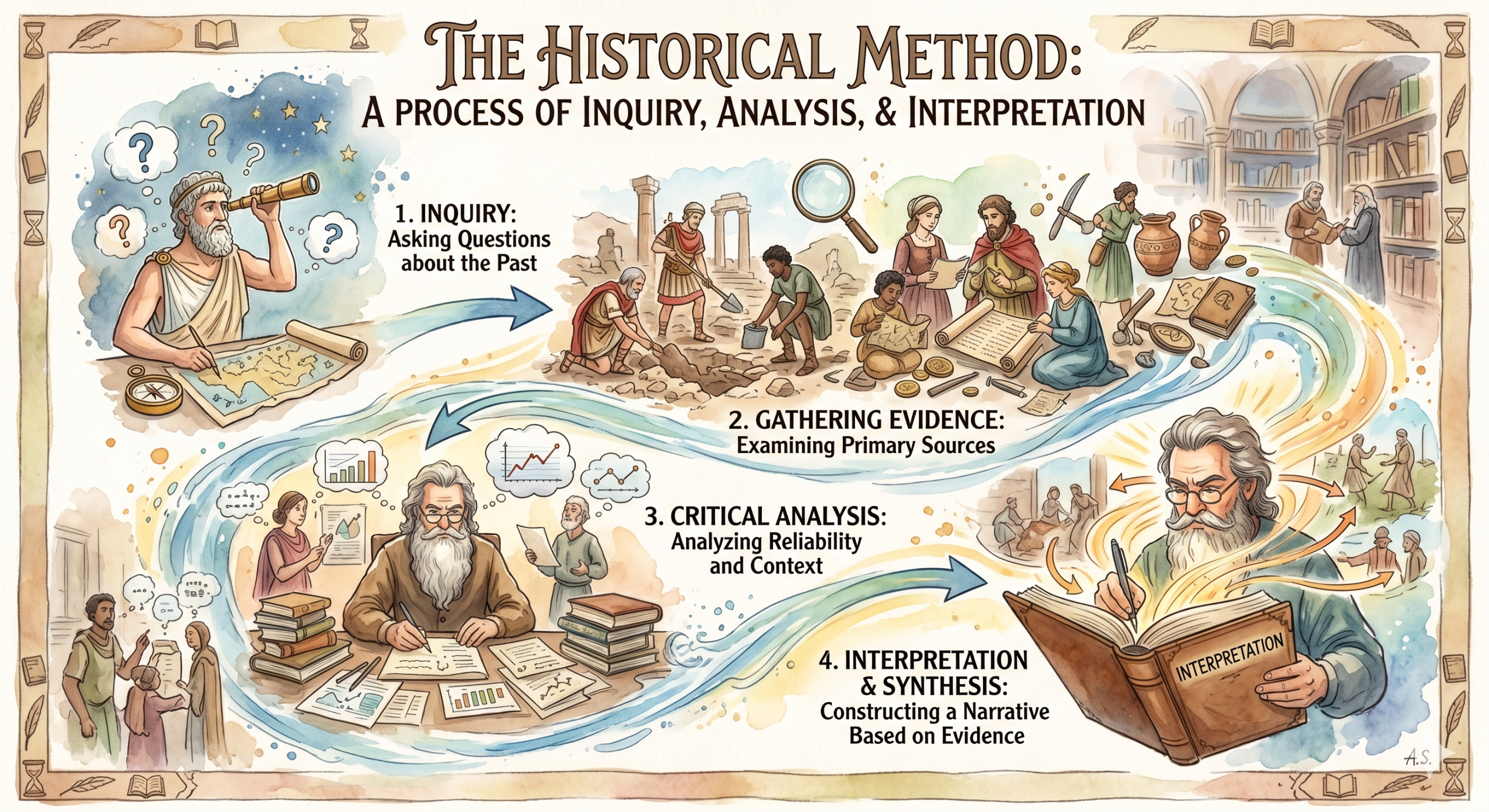
Historians can’t just make things up; they need evidence. This evidence comes from sources:
- Primary Sources: These are raw materials from the past—direct evidence from the time period. Examples include letters, laws, artifacts (like ancient pottery), monuments (like the Obelisk of Axum), and photographs.
- Secondary Sources: These are accounts written after the fact, which analyze or interpret primary sources. Your history textbook, a scholarly article about the Battle of Adwa, or a biography of Emperor Tewodros are all secondary sources.
A good historian must always critically examine sources for their authenticity and potential bias.
Keeping Time: Dating and Periodization
To understand the past, we need to organize it. Historians use dating to place events in chronological order. The most common system is the Gregorian calendar, which uses BC (Before Christ) and AD (Anno Domini). Our own Ethiopian calendar is also a vital tool for studying our national history, and it is 7 to 8 years behind the Gregorian calendar.
Historians also group time into larger chunks called periods. This process, periodization, helps us see major patterns of change. For example, we divide European history into broad periods like Ancient, Medieval, and Modern.
How Historians Work
Activity 1: Check Your Knowledge
Activity 2: Source Sorting
Instructions: Drag and drop (or tap an item to select it, then tap a target box) to categorize each source.
Examples
Source Categories
Primary Source
Secondary Source
Activity 3: True or False
Lesson Summary
History is the inquiry into the human past using written records, while Prehistory studies the era before writing using physical evidence.
Studying history helps us understand the present and develops vital critical thinking skills.
Historians rely on primary sources (first-hand evidence) and secondary sources (later analysis) to interpret events.
Historiography is the study of how history itself has been written and interpreted over time.
Historians use calendars for dating and periodization to organize the past into a chronological narrative.