
History: 9th Grade 13 Sections70 Lessons365 Days
1.5 Africa and Human Evolution
Africa and Human Evolution
History
Lesson Competencies
At the end of the lesson you will be able to:
Explain Africa’s role as the cradle of humankind.
Identify major hominid fossils discovered in Ethiopia.
Understand the process of human evolution from early hominids to Homo sapiens.
Describe the physical changes associated with bipedalism and brain enlargement.
Key Terms
Hominid
The family of primates that includes modern humans and their extinct bipedal ancestors.
Bipedalism
The ability to walk upright on two legs, a defining feature of human evolution.
Paleoanthropology
The scientific study of human fossils to understand human evolution.
Rift Valley
A geological trench in East Africa where many significant early human fossils have been found.
Video Lesson: The Cradle of Mankind
A short introduction to early human discoveries in East Africa.
Core Lesson: Africa and Human Evolution
Introduction
Dear learners,
Imagine walking through a dry, dusty landscape in the Afar region. You notice a small piece of bone sticking out of the earth. You dig it up, and scientists tell you it belongs to a creature that lived over 3 million years ago! This isn’t just a story; it’s a reality in Ethiopia, which is proudly known as the cradle of humankind.
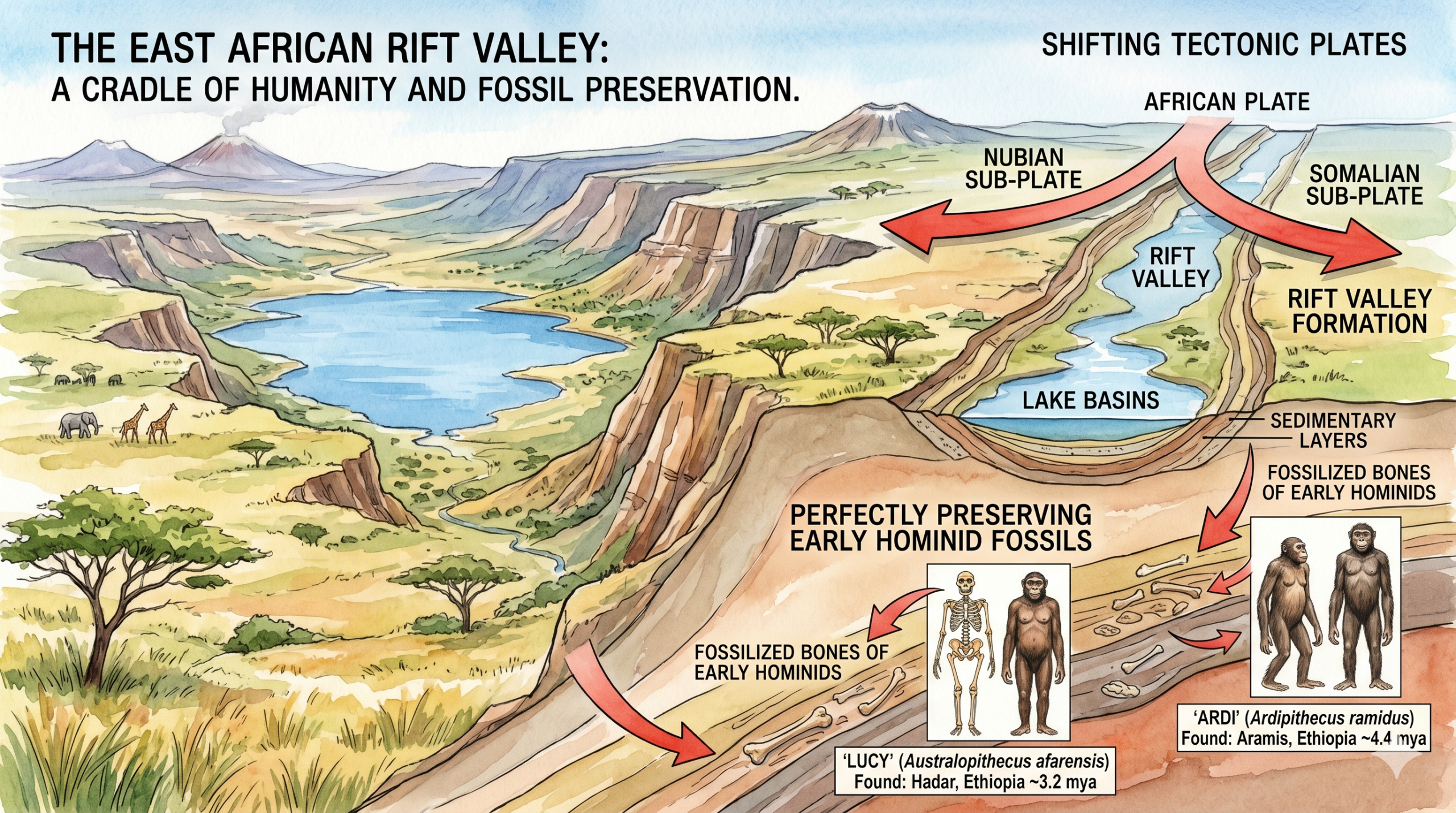
Because of unique geological features like the Great Rift Valley, East Africa has preserved the bones of our earliest ancestors. Let’s explore how humans evolved right here in Africa.
The Journey of Evolution
1. The Earliest Steps (Ardipithecus)
Before humans looked the way we do today, our ancestors lived in forests. One of the oldest known hominids is Ardi (Ardipithecus ramidus). Discovered in the Middle Awash area of Ethiopia, Ardi lived about 4.4 million years ago. She was a crucial discovery because she showed signs of bipedalism while still having a grasping toe adapted for climbing trees.
2. Walking Upright (Australopithecus)
As the climate changed and forests turned into savannas, walking on two legs became an advantage. The most famous example is Lucy, locally known as Dinknesh (meaning “you are marvelous” in Amharic). Found in Hadar by Donald Johanson in 1974, she is 3.2 million years old. Another incredible find is Selam, the “Dikika Baby,” an Australopithecus afarensis child found near Lucy’s discovery site.
3. The Tool Makers (Early Homo)
Over time, hominids evolved larger brains. Species like Homo habilis (the “handy man”) began using simple stone tools. Then came Homo erectus, who discovered how to control fire and became the first hominid to migrate out of Africa into Asia and Europe.
4. Modern Humans (Homo Sapiens)
Finally, our own species, Homo sapiens, emerged in Africa around 300,000 years ago. Some of the oldest modern human fossils, known as the Omo Remains (Omo I and Omo II) and the Herto Bouri skulls, were discovered right here in Ethiopia. From Africa, our ancestors migrated to populate the entire globe—a concept known as the “Out of Africa” theory.
Game: Ethiopian Fossil Match
Activity 1
Tap a fossil name, then tap the correct discovery location to drop it.
(You can also drag and drop on desktop!)
Fossils to Place
Discovery Locations
Evolution Knowledge Check
Activity 2Fact or Fiction?
Activity 3Lesson Summary
Ethiopia is a central part of the cradle of humankind due to numerous fossil discoveries in the Rift Valley.
Ardi (4.4 million years old) is one of the earliest hominids, showing early signs of bipedalism.
Lucy / Dinknesh (3.2 million years old) is a famous Australopithecus afarensis whose skeleton proved early humans walked upright before developing large brains.
The Omo Remains and Herto skulls show that early Homo sapiens lived in Ethiopia before migrating to the rest of the world.
Final Assessment
QuizSelf-Assessment Checklist
Check the boxes below if you feel you have achieved the lesson goals: